
You dust on Saturday. By Wednesday the same film is back on the same surfaces. If that is your house, the problem usually is not how often you clean. It is that something is continuously bringing dust in, or stirring up dust you already have, and no amount of wiping keeps ahead of it.
Here are the causes we actually find in homes around Raleigh and the Triangle, roughly from most common to least, and what fixes each one.
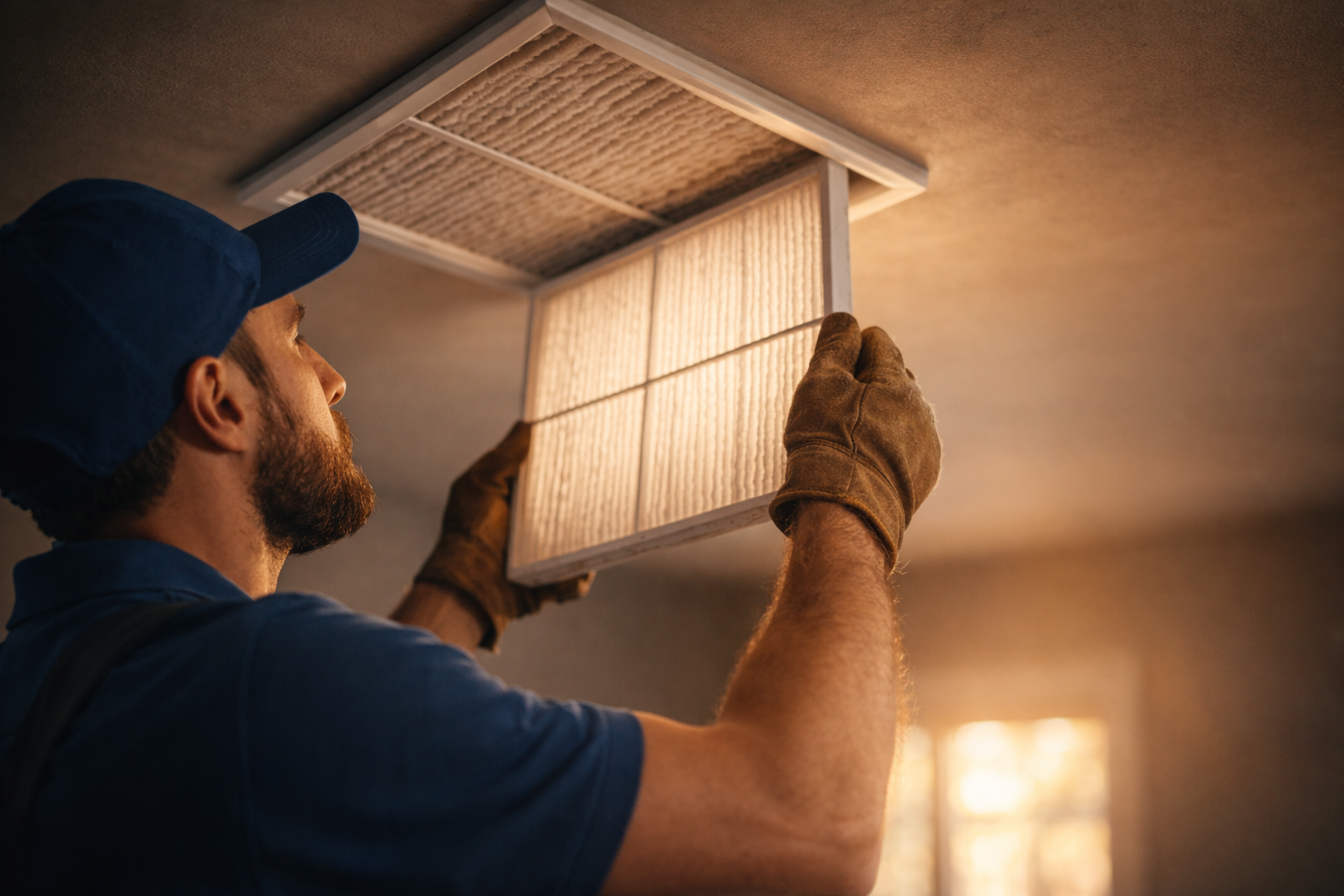
The Filter Is Probably the Wrong One, or Fitted Badly
The cheap fiberglass panel filters are designed to keep large debris off the equipment. They are not designed to clean your air, and they do not. If that is what is in your return, the fine dust that settles on furniture is passing straight through.
The fix is a pleated filter with a higher MERV rating, but with an important caveat. Going too high on MERV in a system that was not designed for it restricts airflow, which makes the blower work harder, hurts cooling capacity and can freeze a coil. A MERV 8 to 11 pleated filter is the safe range for most residential systems. Going beyond that is worth doing only with a media cabinet sized for it.
Fit matters as much as rating. A filter an inch too small, or one sitting loose in an oversized slot, lets air take the easy path around the edges. If you can see gaps around your filter, most of your air is going around it rather than through it.
Leaky Return Ducts Are Pulling In Crawlspace and Attic Air
This is the big one, and it is the one people almost never suspect.
Your return ducts are under negative pressure when the system runs. They are pulling. If there is a gap, a disconnected joint, or an unsealed boot anywhere in that return path, the system pulls air in through it. In a lot of Triangle homes the ducts run through a vented crawlspace or an unconditioned attic, which means every time the system kicks on it is drawing in crawlspace air, attic insulation fibers, and whatever else is down there, and distributing it evenly through the house.
You can sometimes spot the symptom: dust that reappears fastest at the supply vents, a musty or earthy smell when the system starts, or noticeably more dust in the rooms furthest from the air handler. Sealing and repairing the return side is not glamorous work, but in a house with this problem it does more than any filter or purifier will.
Humidity Swings Are Making It Worse
Very dry air lets fine particles stay airborne longer and settle further from where they started. It also raises static, which makes dust cling to surfaces and screens. Very humid air brings its own problems, including the conditions that let mold and dust mites thrive.
In our climate a house tends to swing between too humid in summer and too dry in winter. Holding indoor relative humidity roughly between 40 and 50 percent helps on both ends. On the summer side, that often comes back to whether the air conditioner is sized to run long enough to actually dehumidify. On the winter side, a whole-home humidifier tied into the system does it more evenly than portable units in individual rooms.
The Blower Is Running More Than It Needs To
If your thermostat fan is set to ON rather than AUTO, the blower runs continuously, circulating air even when the system is not heating or cooling. Some people run it that way deliberately for even temperatures. The tradeoff is that it keeps dust in motion all day, and in humid weather it can re-evaporate moisture off a wet coil and push it back into the house.
Switching to AUTO is free and takes ten seconds. If you liked what ON was doing for room-to-room evenness, the underlying issue is usually airflow balance, which is worth fixing directly.
What Actually Helps, In Order of Cost
- Free. Set the fan to AUTO. Check that your filter is the correct size and seated properly.
- Cheap. Move to a correctly sized pleated filter in the MERV 8 to 11 range, and change it on a real schedule rather than when you remember.
- Moderate. Have the return side inspected and sealed. This is the step that fixes the underlying problem in most persistent-dust houses.
- Larger. A properly sized media air cleaner cabinet, whole-home humidity control, or duct cleaning where there is genuine contamination rather than as a routine service.
Worth saying plainly: portable air purifiers help in the single room they are sitting in. They do not solve a house-wide dust problem, and they are frequently sold as though they will.
When It Is Worth Having Someone Look
If you have already replaced the filter with a good one, set the fan to AUTO, and the dust still comes back within days, the cause is almost certainly in the ductwork or in the pressure balance of the house. That is not something you can diagnose from the thermostat, and it is not something a better filter will overcome.
We can inspect the return path, check for leakage and pressure problems, and tell you which of the fixes above is actually worth your money for your house. Call or text (919) 219-9810, or read more about our indoor air quality services.